Sunday, March 27, 2011

ACIS Notes 007 -- Eastern Class Tournament 2011 -- Round 1


CCA Eastern Class 2011 Round 1
This tournament is 5 rounds, starting Friday night for round 1. I took the day off so my roommate and I arrived with plenty of time, ate early,no stress and so on. I am re-energized this year to actually make progress in my chess, as opposed to "dithering around" as the media recently likes to describe such behavior.

Synopsis:
White opened 1.d4 as per usual. With Blacks reply 1...b5 I knew my opponent liked "off beat" openings, and mentally went on alert for traps. This preoccupation with traps held White back. It took a while to feel comfortable with the tensions enough to start asserting my plans. Key points in the game:

  • 6...Be7 -- After this move White is searching for a plan, but gets overly concerned about the Black Bishop on b7. This restrains White from pursuing the Black King, who delayed castling until it was too late.
  • 10...Qc7 -- White really needs to pursue the Black King by restraining the King from castling Queenside, then opening the center. Instead White tries to get a Kingside attack going. The issue is(a)  that Black could simply castle Queenside then what?, and; (b) in order to coordinate the Knights, White goes through an awkward maneuvering and it isn't until much later that the Knights become useful. In the meantime, a Fritz analysis keeps telling White (six times!) that he needs to consider the simple d5 push...
  • 14...Qf8? -- White clumsily pushed the Black Queen back to an unproductive square. Then, White finally realized that he needs to create some Queenside action in order to give Black multiple problems to solve, and plays 15.a4.
  • 17...Bc8 -- White has spent a lot of effort to displace the Black light square Bishop from the long diagonal. Now White feels bold enough to try 18.d5 and open up the position to go after the Black King.
  • 19...Bb7 -- Now White has to continue the plan of pursuing the Black King. Does he push 20.d6, or try to crack open the Black King defenses with 20.dxe6? Or some other move? 20.d6 will restrain the Black dark square Bishop (good). 20.dxe6 begins to chip away at the Black King defense, but is there something quicker? Fritz suggests 20.cxb4, but I'm not sure why this is good. The engine doesn't reveal an immediate tactic, so there is something positional that I do not understand.
  • 29...Rxg6 -- After missed tactics on both sides, and a rushed exchange of Queens on White's part, we have a position where Black has a huge weakness on the d7 square, White has a Rook on the d-file, and two Knights trained on d6 in front of the d7-pawn. White initiates operations against the last defense of the Black King with 30.Ncd6.
  • 33...cxb4 -- White can choose to maintain or increase the tension if he wishes. Fritz recommends 34.a5 to maintain tension, while Goldowsky ("ChessWriter") recommends 34.h4. White played 34.Nxe7 releasing the tension, likely lengthening the game.
  • 35...a5 -- Allowing White to exchange Bishops with 36.Bb5, and the rest of the game is inevitable.


Sunday, February 20, 2011

ACIS Notes 006 -- Periodic Update

I'll make an effort to give a terse periodic update of where I am at in "The Hills of Sisyphus"... maybe every few weeks? We'll see how long I can keep this up :-)


  • chess.com -- 1471
  • chess.emrald.net -- 1260
  • chesstempo.com -- 1536
  • CT-ART 4.0 -- 1835


  • MetroWest CC play resumes March, Tuesday nights 40/90, SD30
  • Eastern Class March 4-6, 2011
  • Three(3) chess.com games
  • Five(5) CCLA games


  • Silman, Reassess v4, finishing up Part 3 Rooks

My goal obviously is to improve my play. A big test will be the Eastern Class tournament. I'm 1399 in Class D (1200-1399). Although I'm the highest rated, there are always a few scholastic stars who shoot up in those sections, so I'm not expecting a perfect score. However, I am determined to get a competitive result.

Am I boning up on openings? No. Tactics? Yes. Strategy? A bit, via Silman. Endgames? No. 

I'll give an update late in March after the Eastern Class.


Saturday, February 19, 2011

ACIS Notes 005 -- Three Hills of Sisyphus


Fans of chess improvement have no doubt heard on "The Seven Circles", a term coined by MDLM and used by Knights Errant extensively. If you are not familiar, then I recommend the blog by Blunderprone (see "My Blog List" on the right) for history and humor of the "movement". The Seven Circles is a method to improve your chess via practicing tactics. There have been plenty of anecdotes pro/con, and some quantitative evidence in its favor. I've even tried, but I can't get completely through even the first circle - I get jammed midway around level five of CT-ART.

So I stall, give up, come back to it, realize I truly suck in the openings, fret about that, but never formulated a plan I could stick with for any period of time. I'd like to stick to a plan for a while, so I can measure and see if the plan is working. For as much as some people say "don't worry about your rating", what other measure is there really, to say that you are improving? I think rather the statement should be "play and practice as hard as you can, and while doing so, don't think about your rating". But you still need to step back periodically and see if what you are doing works.

Recently I got tired of my free fall in USCF rating, and decided to do something about it. Was it my intense work schedule making me tired for night games at MetroWest CC? Am I truly incapable of learning openings? Is age a factor? Am I capable of the willpower chess demands? I thought about my chess and work and decided to be a bit more disciplined and systematic about how I approach chess. It helps in work, and who knows, maybe in chess as well. I've been developing this method, and gradually formalizing it in my head. Most recently I'm trying to put some real structure around it, so when I get 15-30 min free time I can exercise a bit of the method. Part of the method is getting away from the notion that the only way I can improve is if I can grab several hours at a time. That is simply too unrealistic and has held me back.

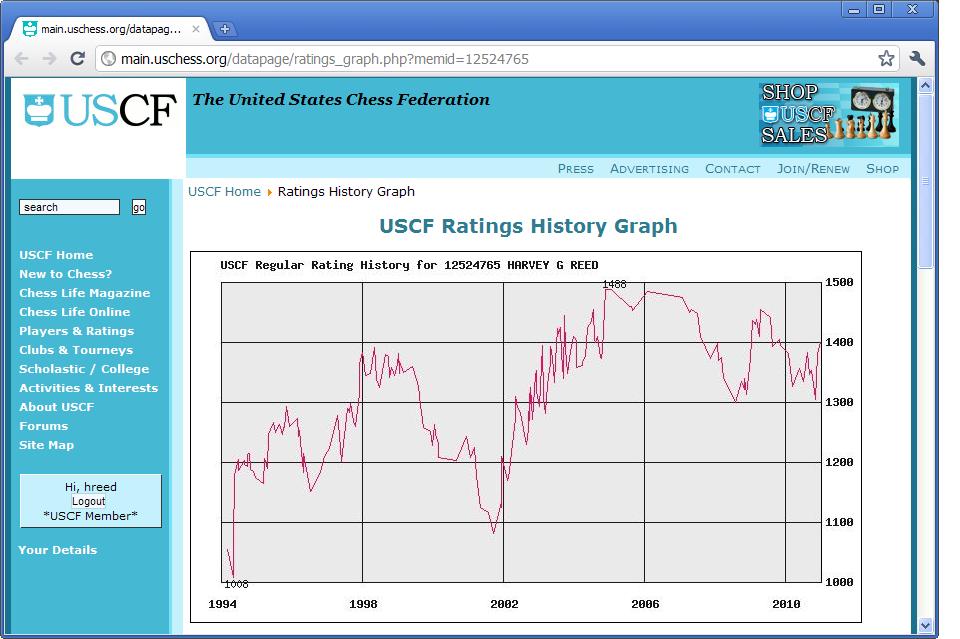
I've been down this new path just a couple of months and already regained ~100 USCF ELO points. That's not very impressive if you note that I am all the way back to 1399... but still. The chart is below, and you'll have to squint to see the up tick in the last couple of months...


So what is going on? Is this last up tick significant, or just another fluctuation on my slow but sure spiral downward to my floor of 1000? I'd like to think that I am at an inflection point of steady improvement. I'll show below how I am trying to think a bit more holistically about my chess improvement, and have grouped my activities into the "Three Hills of Sisyphus", take-off on the phrase "Seven Circles"...

Hill One - Drills

This hill of Sisyphus is all about tactical drills. The pure MDLM method is CT-ART, but I've found that no matter what packaged set of drills you use, there are biases, so why not rotate? People criticize CT-ART for too many queen sacrifices, Emrald for too fast time controls, etc. I forced myself (yes, unpleasant at first) to learn how to use and appreciate four tools. There are many others but here is what I am using, and how:


This hill is the best when I just have a few open minutes. The ideal is to start with a few chess.com tactics. I am a "Gold" member, so I get 30/day. The time control is relaxed, and you get partial credit for making it part way through a sequence. This is good for warm up, so my rating on this one is probably artificially low (~1300). The next is chess.emrald.net for the Chess Tactics Server. This experience is like a series of flash cards, and to get full credit, you need to answer within three(3) seconds. A lot of "remove the defender" and "king hunt", and after a while you try to get "an eye" for hanging pieces and such. My Emrald  rating is ~1200-1250. Next is chesstempo.com tactics training, and this one allows for much more time, and the problems are harder. My rating is >1500. Last is CT-ART v4 and I alternate between theme and difficulty. Current I'm sorting by difficulty and doing all the counterplay examples too, but in practice (untimed) mode. My rating on this is >1800. Sample screen shots of ratings below. I'm starting to get in a groove, and I expect my tactical performance to increase substantially over the next few months.


Hill Two - Praxis

This hill of Sisyphus is all about practice. Since I have a crazy work/travel schedule, I use a combination of OTB and correspondence chess games. The OTB games are usually long, and primarily via MetroWestChess.org, and CCA (chesstour.com) weekend tournaments. The correspondence chess is both casual as in chess.com, and also official such as CCLA (chessbymail.com).


I'm trying to overcome some bad habits with this new approach to praxis. For example in my CCLA (or ICCF) games, I would obsess over moves, sometimes looking at 20-30 variations at each move, which gave me a good rating (ICCF >1700), but I never got a feel for the overall game, and thus I never really improved much. So in my recent CCLA games, I'm trying to move quicker and think overall themes. My CCLA rating is ~1550. In my chess.com games I'm trying to get better at my annotation, which is aided by the fact that the games are already online and easily accessible. I still have a mental hurdle with my other OTB games because my CB database is such a mess. I am thinking about simply starting a new DB for my Eastern Class games (Mar 2011) and make a fresh start. My MetroWest CC games will follow suit.

Hill Three - Skills

This hill of Sisyphus is all about putting everything together into a balanced set of skills. This is still emerging but is roughly divided into book knowledge, multimedia DVD training, reviewing master games, and recording what I want to play as a repertoire.


The current incarnation of this hill of Sisyphus is as follows:

For book knowledge I am going through the Silman Reassess v4. This is a great improvement over v3 which I found tiresome because of the obsession with Bishop v. Knight. That is important but there are many other imbalances, and that is exactly where my games fall apart. In v4 Reassess the #1 great feature are his exercises in which he assigns a rating band, and tells you why (similar to his rating bands in his endgame book). I can now see some curious gaps in my knowledge. For example, in a number of exercises, I can "see" a move for a "2000" rated player but will miss some features of that position he expects a 1600-1800 player to get - and some of these features will determine whether the "2000" level move would work or not in a real game. As I worked through more of these, I realized that where I was going wrong is in not "seeing" the whole board, and that there can be multiple themes of activity, competing activity, going on simultaneously. This incomplete board vision surfaces in tactics exercises too...

For training DVDs, I am currently working through some opening Fritz trainer DVDs for openings (General ABCs, Queen's opening, French Defense, etc.). I am not trying to memorize lines. I am trying to continue picking up on structure and theme ideas (continuation of my earlier ACIS Notes blog entries). I was surprised to learn that the most important thing I am picking up in my first pass is what really is and is not "scary". I'm learning how Masters evaluate positions, and just hearing them speak about various positions, and what is most important to them is invaluable. All without memorizing any lines.

For game collections, this varies between looking at a player's games (like a Petrosian collection), and looking at a tournament book (like Zurich '53, or Curacao '62). Currently I'm going through a Curacao book, but that is on hold right now.

For repertoire, this is my true missing link. I recently downloaded the latest in Bookup, and once I get done with Eastern Class, my pledge to myself is to annotate my games, and start building an e-book of White and Black repertoires.

The Hills Are Alive With The Rocks of Sisyphus

I don't have a lot of time, so the way I work my way through the Hills of Sisyphus is as follows:

At least every other night spend 30 minutes pushing rocks up the Drill Hill. I try to get through chess.com and Emrald at a minimum , usually some chesstempo.com, and on the weekends toss in some CT-ART. Most nights I push rocks up the Praxis Hill (30 min) checking moves in a few correspondence games (< 10 at any given time). At night, spend ~30 min with a book. On travel days, maybe every other weekend try some chapters out of the DVDs. The repertoire, well that's still a twinkle in my eye.

So I have boiled this down to about an hour a day, which is too much for some, way too little for others. I'll see over time if it is the right amount for me.

Saturday, March 13, 2010

ACIS Notes 004 -- First thoughts on pawn chains

'm starting to go through Colin's Pawn Chains book (see previous post), and making mental notes about what I think I need to learn. Colin's book is about pawn chains, which is just a subset of all pawn structures, and then focuses on central chains. As focused as the topic is, it is very important and these structures come up in a lot of openings.

NOTE to readers. I am a chess novice. I am not an expert. In this blog I am trying to see if I can explain concepts in simple language, so that I might actually learn it. I need all the smart people out there to let me know where I get confused, and what I need to correct it. If I get something right, let me know :-)

The first few moves of the French opening are 1.e4 e6 2.d4 d5. This is the quintessential fight for the center, and now White has to decide what to do next:


The decision making process is repeated for every move until the chain is fully formed. Do we keep the tension or release it? If we release the tension, do we use pawn exchange or pawn advancement? The diagram below is a schematic of the considerations at every move:


For each move prior to the completion of the chain White can maintain or release tension. All the while, Black has a clear shot at exchanging on d4, and looks for the right time (if ever) to liquidate.


Quite often, the White pawns on d4 and e5 are attacked and exchanged, by the Black pawns on c5 and f6. When that happens Black has three pawn islands, to White's two pawn islands. Further, the Black d5-e6 pawn chain constitute "hanging pawns". If Black can get the pawns moving they will be a powerful force. White's job is to stop them in their tracks. The strategy is to block the pawns by attacking or occupying the d4 and e5 squares (red squares).


Finally, as is typical in a hanging pawn situation, Black can take full advantage of the half-open files on the c-file and f-file (red arrows).

ACIS Notes 003 -- I'm Back & positional vs. strategic? & quick update

I'm Back From the Caribbean

Yes, the Caribbean, quite awesome. We've been going for years, and this was the first time we had a flight disruption that resulted in us staying an extra day. It was during the wicked strong snowstorms that hit the mid-Atlantic. But no, it wasn't a snow cancellation, it was because of a nearby volcanic eruption (Monserrat)! Yes, we were "forced" to stay an extra day on the beach, listening to the waves pound the shore...


However, the place on the beach for this extra day was literally right next to the airport - LOL!

While we were there, in our usual place on the other side of the island from the airport, we did the usual sun, beach, pool, hot tub, pool, etc. And I got plenty of reading in. Great news, I finally broke my mental block concerning tactics. I made it all the way past "deflection" and completed John Nunn's "Learn Chess Tactics". I don't know why, but the last time I tried his book, I failed at deflections. Now I made it with ~80% success. Now I am in the last chapter of "Miscellaneous" grinding along, also using Pocket Fritz 4 (much better than Pocket Fritz 3) and CT-ART 4 (much better than CT ART 3) for tactics. The mental block of tactics has been lifted, now it is "just" practice, practice, practice...

Bottom line, I feel much more confident in tactics (not over confident). I know that doesn't necessarily translate to anything positive unless other good things happen...

I also finished Grooten's book (see previous posts) and I have to say it is an awesome inventory of techniques. But how to put it all together? For this I read Stean's "Simple Chess". This book is small, not too many variations, and an awesome read. At the end I understood the main point which is that the pawn structure determines your game. Duh. I intellectually knew that when I started my "adult onset" chess in the 90's, but I didn't have a visceral feel like I got when I read Stean's book. Not that I can replicate his genius, but I am slowly getting it.

And part of the "getting it" is the linkage between tactics, pawn structure and openings. I frequently complain about folks who "just study openings", yet at the same time drool at how they can get great positions using 3 minutes on their clock and without breaking a sweat (arg!). Yet I still struggle mightily in the opening. So who is the chump?

How can I "study openings" (even better, understand them!) without all of the apparent memorization? Well, perhaps I can treat it like tactics, something like:
  • If I can learn tactics by going through drills of particulars, but try to memorize only the patterns...
  • Then maybe, just maybe, I can learn openings by studying lots of pawn structures and transformations (such as in in Soltis' "Pawn Structure Chess") and doing an OODA loop such as...:
    • Study a pawn structure
    • Review a number of GM games
    • Then look at a few related opening "book" sequences
    • And (drum roll...) what are the typical tactical motifs for each opening sequence?
Perhaps this will help me avoid the "why the heck am I just memorizing stupid opening lines??" feeling. Maybe. So now I start the quest of pawn structure knowledge. Curiously, years ago Igor Foygel dropped by my house to give me a lesson while he was on the way to a scholastic tournament where he had some students playing. The lesson was to go through all my books and pick out two or three to study. He basically said all the books are useless (to me, the chess novice) except for two or three. In addition to tactics (of course!) which I am finally making progress on, he shoved a copy of a book by Colin Crouch "Pawn Chains". I can't find it in Amazon, Powells, and so forth so here is a snapshot:
I'll be using this as I finally try to figure out pawns...
    Positional vs. Strategic?

    In the introduction of Soltis' "Pawn Structure Chess" there is a game in which Soltis makes a seemingly innocuous remark, perhaps obvious to all the readers, but was shocking to me, then I had a realization. First the game:

    At 11.Ne1, the game (to my chess novice eyes) appears to be a typical French. Soltis says that with White's last move, he is preparing for a Kingside advance. This certainly makes sense (moving the Knight out of the way), but I would wonder if that is too slow (compared to what?). Black responds with 11...f5 successfully blocking White's advance with the f-pawn, and locks the Kingside. Soltis says while it is "structurally sound", it is "dynamically bad". Hmmm... Then White moves 12.b4 and Black takes en passant 12...cxb3. Soltis again makes a confusing statement (to my chess novice eyes) when he says Black's move was "positionally desirable" and "strategically awful". Whew! What am I to make of this? Can any reader please tell me their thoughts?

    Quick Update

    Of course if you play the rest of the above game out, you'll see that White wins, but is this proof of anything? I don't know, but it did make me think, and try to relate to a discussion with a fellow MetroWest Chess Club member while we were eating a meal before a round at the recent CCA Eastern Class Championship tournament. For the voyeuristic reader, I played four games (skipped the last round), and won one game, close in two others, and wiped out in my first game to the lowest rating player I played. Despite the paucity of points, I was generally pretty happy with my performance considering the crushing work schedule I keep. I am working to ameliorate that, but it won't subside till summer.

    Back to the dinner conversation The fellow MetroWest CC player is Robert Harvey and he is playing in the MetroWest CC Championships (Class level) this month so he is very strong. He goes on to tell me that his decision making strategy is guided by "I.M.P.L.O.D.E.S.". Honestly when I heard him say that, I thought "dang it I do that all the time over the board, why do I need help on that??"... Here is how he explains himself:

    • (I) - initiative
    • (M) - material
    • (P) - pawn islands (not necessarily all pawn structural aspects)
    • (L) - [I'll update if I remember]
    • (O) - officers, what is the relationship between his minor pieces (Knights, Bishops)?
    • (D) - [I'll update if I remember]
    • (E) - [I'll update if I remember]
    • (S) - space - oddly he puts space last. I think because he includes some of this in how he explained initiative (he counts how many times his pieces "invaded" his opponents territory)
    He then went on to say that from an opening/pawn structure perspective, he concentrates 80% of his energy on the Colle as White, and Modern as Black. I won't go into the specifics of his preparation (some of it home grown), but suffice it to say he has a routine, a groove, that he uses 80% of the time, and takes the time to improve his body of knowledge. Me on the other hand am grasping in the dark for a decent opening, and then I find myself opting for moves that Soltis calls "positionally great" and "strategically awful" all at the same time. Arg!!

    That's it for now. I'm still sorting my thoughts out, doing tactics daily (finally) and beginning my personal pawn structure/GM games/openings study journey...


    Sunday, January 3, 2010

    Just do it!

    I caught this in a recent "Lifehacker" post.

    The philosophy makes sense and is in the spirit of ACIS in general, and my personal program specifically. I've given up trying to figure out a "perfect" curriculum for me. But I have embraced full-on "just do it", to the max. Right now I'm focusing on Grooten's book and I'll be going back to play at MetroWest CC this week. What if I "fail" in something? That'll put me one step closer to improving. While I go through the Grooten book, I try to work out the tactics in the examples so I haven't ignored that part too much :-)

    I'm up to Chapter 16 of "Chess Strategy for Club Players" by Grooten. I can't say this enough -- this book:
    • has not invented anything new,
    • is "merely" recycling material from back in the Steinitz days (old!),
    • and this material was rehashed by Nimzowitsch in the 1920's (old and rehashed!)
    and still... many authors have tried to be a compendium of middlegame strategy, for example Euwe (I have it but have not read his two volume set), and Silman (especially his Reassess book which I have read - almost - twice). The Silman book makes intellectual sense (at some level) to me, but I can't internalize it, or put it into practice.

    So why the heck am I still reading Grooten?? And why is it practically a page-turner-suspense novel for me? I put in all (except the most trivial) positions, game fragments or complete games either into Fritz 12 (thank you Santa this year!), or PocketFritz3 (thank you Santa last year!). I play through it all, comparing what the book says, vs what Fritz says, vs what I was thinking. Very time consuming, and yet (compared to other chess books) I am flying through it, and up to p. 240, and zooming along.

    Why is the book so compelling? I can't really explain except to say that it is teaching me about all the pieces, all the pawns, and more importantly all the muscle movements. In contrast, Silman's book is relatively one-dimensional, constantly focusing on whether the bishop or knight is stronger. But why the heck would one be stronger than another? That - is what the Grooten book teaches me, and the examples are perfect (for me) in illustrating principles in action. Then there are four(4) quiz problems after each (short) chapter to get the reader to participate. All the examples and quizes are from real games, IM to super-GM strength.

    I guess the best way to sum it up is that Grooten breaks down the concepts into the right bite size pieces, in the right order, and then focuses on the muscle movements (active, process) to do in various situations, with excellent examples. And then frequently puts emphasis on what the decision making process is, tradeoffs, and so on.

    I've never been this enthusiastic about a chess book before, maybe that is a good sign in and of itself...

    Sunday, December 20, 2009

    Winter Storm Crimps ACIS Notes

    The "Blizzard of 2009" put a big crimp in my ACIS activities this weekend. For example, I wanted to respond to Phaedrus' comments on my ACIS-Notes-002, but a snow storm that left way over a foot (~35cm) of snow had me shoveling for over four hours... Ugh. I think Blunderprone had a similar fate...

    Next weekend...